Pokémon Timeline Explained: The Complete Pokémon Universe
Understanding the Pokémon Universe
The Pokémon universe is one of the most expansive and detailed fictional worlds ever created. It spans video games, television series, movies, manga, and countless spin-offs. Each generation of Pokémon games introduces new regions, Pokémon species, and stories, making the universe rich and complex. With over 1,000 Pokémon discovered so far, it can be challenging for fans to keep track of how all the events and characters fit together. Understanding the Pokémon timeline helps fans make sense of these stories and see how the universe develops across generations.
Central to the Pokémon world is the bond between trainers and their Pokémon. Trainers embark on journeys to catch, train, and battle Pokémon. Each Pokémon has unique abilities, types, and evolutionary paths. Legendary and mythical Pokémon often play crucial roles in shaping the history of the Pokémon universe. These creatures are tied to ancient myths and events that influence the present-day regions and stories. Understanding their origins is key to following the overall timeline.
The Pokémon universe also evolves with technology. From simple Pokédex devices in early games to modern advancements like Dynamax and Mega Evolution, technology impacts both Pokémon battles and exploration. Different regions develop unique technologies and battle strategies, which shape the culture and history of Pokémon societies. Legendary teams and villainous organizations use advanced technology to pursue their goals, creating conflicts that affect multiple generations.
Fans of the Pokémon anime and movies may notice that the storylines sometimes differ from the games. While some events are considered canonical, others explore alternate scenarios or offer side stories. Despite these variations, the core timeline of the Pokémon universe remains consistent across major games. Understanding the sequence of events helps fans appreciate how regions, legendary Pokémon, and key characters connect over time.
This blog will provide a complete guide to the Pokémon timeline. It will cover the origins of legendary Pokémon, the stories of each region from Kanto to Paldea, and the roles of villainous teams and organizations. It will also explain how spin-offs, movies, and anime crossovers fit into the broader universe. By following this guide, both new and longtime fans will gain a clear understanding of the Pokémon universe and its rich history.
The Origins: Ancient Myths and Legendary Beginnings
The story of the Pokémon universe begins long before trainers embarked on their journeys. At the center of creation is Arceus, often referred to as the original Pokémon. According to lore, Arceus shaped the world and created other legendary Pokémon to maintain balance. These include Dialga, Palkia, and Giratina, who control time, space, and antimatter, forming the foundation of the universe’s structure.
Mew is considered the ancestor of all Pokémon, holding the DNA of every species. Its mysterious nature and rarity make it central to myths and legends. Ancient Pokémon like Groudon, Kyogre, and Rayquaza shaped the earth, seas, and sky, often engaging in epic battles that influenced the land and climate. The stories of these primordial Pokémon are referenced throughout later generations, showing their lasting impact on the world.
The mythology also includes the creation of regions. Hoenn, Sinnoh, and other lands have legends tied to their most powerful Pokémon, explaining natural disasters, mountains, and oceans. For example, Groudon’s emergence brings droughts, while Kyogre’s power creates floods. Rayquaza acts as a mediator, restoring balance. These stories demonstrate how Pokémon influence the physical and cultural development of their regions.
Ancient humans and civilizations are also part of the lore. Temples, ruins, and artifacts found in games often reference historical events and the worship of legendary Pokémon. These myths connect the past to the present, giving trainers insight into how Pokémon and humans have coexisted for centuries.
Understanding these origins is crucial for following the timeline. Every major event in Pokémon history ties back to these legendary beginnings. Trainers, teams, and legendary Pokémon all interact in ways influenced by these ancient stories. By learning about the origins, fans can better appreciate the connections and conflicts that appear in the games, anime, and movies.
Generation I: Kanto Region and the Beginning of Trainers’ Journey
The Pokémon journey officially begins in the Kanto region, introduced in Pokémon Red, Blue, and Yellow. Kanto is home to iconic Pokémon such as Pikachu, Charmander, Bulbasaur, and Squirtle. Trainers begin their journeys in Pallet Town, guided by Professor Oak, who provides a starter Pokémon and the original Pokédex.
Kanto introduces Gym Leaders like Brock, Misty, and Giovanni, the latter also serving as the head of Team Rocket. Team Rocket is the first villainous organization players encounter, attempting to steal Pokémon and disrupt the balance of the region. These events lay the foundation for recurring villainous teams in later generations.
Legendary Pokémon play a key role in Kanto’s timeline. Mewtwo, created through genetic experimentation, represents the ethical dilemmas of human intervention in Pokémon biology. The legendary birds Articuno, Zapdos, and Moltres inhabit remote locations and are linked to Kanto’s natural balance. Encounters with these Pokémon shape the region’s history and lore.
The Red and Blue storyline establishes recurring themes seen in later generations: trainer growth, Pokémon bonds, legendary conflicts, and the rise of villainous organizations. Kanto also introduces basic technology, such as Pokédex devices and Poké Balls, which become central to gameplay and storytelling.
By completing the journey in Kanto, trainers set the stage for exploration in other regions. Connections to future regions, such as Johto, are hinted at with certain events and legendary Pokémon appearances. Kanto’s history forms the backbone of the Pokémon timeline, making it essential for understanding the entire universe.
Generation II: Johto Region and Expansion of the Universe
The Johto region expands the Pokémon universe with Pokémon Gold, Silver, and Crystal. Johto is located near Kanto, creating natural links between the two regions. Trainers explore new towns, encounter new species, and learn about Pokémon breeding, a major gameplay and story feature. Breeding introduces new strategies and strengthens bonds between Pokémon and trainers.
Legendary Pokémon in Johto include Lugia, the guardian of the seas, and Ho-Oh, who represents hope and renewal. These Pokémon have deep connections to Kanto’s legends, tying together the lore of multiple generations. For example, Ho-Oh is said to have resurrected the legendary beasts Raikou, Entei, and Suicune, linking Kanto’s mythos to Johto’s events.
Johto also sees the rise of more complex villainous teams. While Team Rocket continues its operations, the region’s unique challenges test trainers’ abilities to manage both Pokémon and strategy. Legendary encounters often require understanding history and myths, further connecting gameplay to the Pokémon universe’s larger story.
Technological advancements in Johto include improved Pokédex data, new battle strategies, and the ability to breed Pokémon to create stronger offspring. These features expand both the narrative and gameplay experience, giving trainers more ways to interact with their Pokémon.
Johto’s timeline shows the growth of the Pokémon world. It bridges the early stories of Kanto with the developments in later regions. Trainers who explore Johto gain insight into the expanding universe, the influence of legendary Pokémon, and the ongoing impact of human and Pokémon interactions.
Generation III: Hoenn and Technological Advancements
The Hoenn region, introduced in Pokémon Ruby, Sapphire, and Emerald, brings new landscapes, climates, and legendary conflicts. Hoenn is known for its unique geography, including deserts, oceans, and volcanoes, making exploration and Pokémon encounters more varied. Trainers face Gym Leaders with specialized strategies and new challenges.
Hoenn introduces the legendary weather trio: Kyogre, Groudon, and Rayquaza. Kyogre controls the oceans, Groudon governs the land, and Rayquaza maintains balance between them. Their conflicts shape Hoenn’s climate and terrain, showing how legendary Pokémon influence entire regions. Trainers often intervene in these events, tying human action to Pokémon lore.
Hoenn also sees significant technological advancements. The Battle Frontier is introduced as a testing ground for trainers seeking higher-level challenges. Pokémon Contests allow trainers to showcase skills beyond battles, deepening the bond between humans and Pokémon. Communication devices, Poké Marts, and transportation systems in Hoenn reflect the growing complexity of the Pokémon world.
Villainous teams like Team Magma and Team Aqua add new dimensions to the timeline. Team Magma seeks to expand land through Groudon, while Team Aqua wants to flood the world with Kyogre. These conflicts demonstrate the ongoing theme of humans attempting to manipulate legendary Pokémon for personal goals, reinforcing ethical questions seen in earlier generations.
Hoenn’s events influence future regions. Legendary Pokémon reappear in later generations, and the myths surrounding Kyogre, Groudon, and Rayquaza continue to shape the overarching Pokémon universe. Trainers who complete Hoenn’s journey gain a deeper understanding of the interplay between legendary Pokémon, human ambition, and environmental balance.
Generation IV: Sinnoh and the Rise of Legendary Conflicts
Sinnoh, the setting of Pokémon Diamond, Pearl, and Platinum, focuses on legendary conflicts and complex storytelling. The region is home to Dialga, the master of time; Palkia, the master of space; and Giratina, the guardian of antimatter. These Pokémon represent fundamental forces, showing how legendary Pokémon control not just regions but aspects of reality itself.
Team Galactic emerges as Sinnoh’s main villainous organization. Led by Cyrus, Team Galactic seeks to remake the universe using Dialga and Palkia. Their actions threaten the balance of existence, and trainers must intervene to prevent catastrophic consequences. These events deepen the ethical themes of human interaction with Pokémon power.
Sinnoh introduces more sophisticated technology. Poké Marts, advanced Pokédex models, and improved battle systems reflect the region’s modernized society. Sinnoh’s mythology also connects with ancient Pokémon origins, bridging the primordial stories with present-day events.
Other legendaries like Heatran, Regigigas, and the Lake Guardians create subplots, showing that legendary Pokémon influence human history and natural phenomena. Trainers encounter these Pokémon to restore balance and protect the world, reinforcing the recurring theme of humans and Pokémon working together.
Sinnoh’s timeline plays a critical role in the overall Pokémon universe. It highlights the scale of legendary Pokémon power, the consequences of human ambition, and the importance of balance. Events in Sinnoh echo through later generations, making it a key chapter in the Pokémon timeline.
Generation V: Unova and New Beginnings
The Unova region, introduced in Pokémon Black, White, Black 2, and White 2, is the first major region set outside Japan’s geography. It brings a fresh perspective, new Pokémon, and a focus on ideals. Legendary Pokémon Reshiram and Zekrom represent truth and ideals, while Kyurem embodies the absence of these qualities. Their conflict highlights philosophical themes within the Pokémon universe.
Unova introduces advanced urban environments, reflecting the modern human-Pokémon relationship. Villainous teams, primarily Team Plasma, challenge trainers to question morality and the treatment of Pokémon. Unlike previous generations, Unova emphasizes ethical storytelling and narrative depth.
New gameplay mechanics, such as rotation battles and triple battles, showcase technological and strategic evolution. Trainers must adapt to different formats and Pokémon abilities. Legendary Pokémon encounters remain central to the storyline, connecting Unova to the broader timeline and the history of Pokémon ideals.
Unova expands the Pokémon universe by introducing fully independent regions with their own culture, technology, and legendary Pokémon. The events in this region demonstrate that the Pokémon world is continually growing while maintaining connections to past legends and regions.
Generation VI: Kalos and Mega Evolution
The Kalos region, introduced in Pokémon X and Y, highlights beauty, innovation, and Mega Evolution. Legendary Pokémon Xerneas and Yveltal embody life and destruction, while Zygarde maintains balance. Mega Evolution allows certain Pokémon to temporarily transform, enhancing their powers and adding strategic depth to battles.
Kalos connects to previous regions through legendary lore and trainer journeys. Villainous team, Team Flare, seeks to dominate the world using powerful Pokémon, showing recurring human ambition and ethical conflicts. The introduction of Mega Stones and advanced Pokédex models reflects technological growth in the Pokémon universe.
Trainers in Kalos experience a region with rich culture, diverse environments, and new gameplay mechanics. Kalos’ events demonstrate how Pokémon society continues to evolve alongside human civilization.
Generation VII: Alola and Regional Changes
The Alola region, featured in Pokémon Sun, Moon, Ultra Sun, and Ultra Moon, introduces island culture and unique Pokémon forms. Legendary Pokémon Solgaleo, Lunala, and Necrozma drive the region’s story, emphasizing cosmic balance. Alola’s regional forms of existing Pokémon show adaptation to new environments.
The story focuses less on villainous teams and more on cultural exploration and Pokémon bonds. Advanced technology like Z-Moves and trial challenges adds depth to gameplay. Alola demonstrates how Pokémon society evolves with environment and culture while maintaining links to the broader timeline.
Generation VIII: Galar and Dynamax Era
Galar, introduced in Pokémon Sword and Shield, brings Dynamax and Gigantamax mechanics. Legendary Pokémon Zacian, Zamazenta, and Eternatus define the region’s historical and modern conflicts. Trainers face new challenges, explore urbanized regions, and confront industrialization issues.
Villainous teams and organizations continue to appear, reflecting ongoing human ambition. The Galar timeline reinforces Pokémon themes of balance, growth, and collaboration between humans and Pokémon.
Generation IX: Paldea and the Modern Pokémon World
Paldea, in Pokémon Scarlet and Violet, represents the modern era of the Pokémon world. Legendary Pokémon Koraidon and Miraidon guide trainers through new adventures. Paldea shows ongoing evolution of Pokémon society, new gameplay mechanics, and connections to past regions. Trainers continue to explore, battle, and strengthen their bonds with Pokémon, keeping the universe alive and expanding.
Spin-offs, Movies, and Anime Crossovers
Spin-offs, movies, and anime events often explore alternate stories. Movies like Mewtwo Strikes Back and Detective Pikachu offer additional perspectives on Pokémon lore. Some crossovers create canonical debates, but all contribute to understanding the Pokémon universe’s richness. Fans can enjoy these stories while following the main timeline for context.
Technology, Teams, and Organizations in the Timeline
Throughout generations, technology evolves with Pokédex, Poké Balls, and battle systems. Villainous teams like Team Rocket, Team Magma, and Team Galactic challenge trainers and influence Pokémon history. Technology and organizations shape the universe, showing the interaction of humans, Pokémon, and legendary forces across time.
Summary: Complete Pokémon Timeline Chart
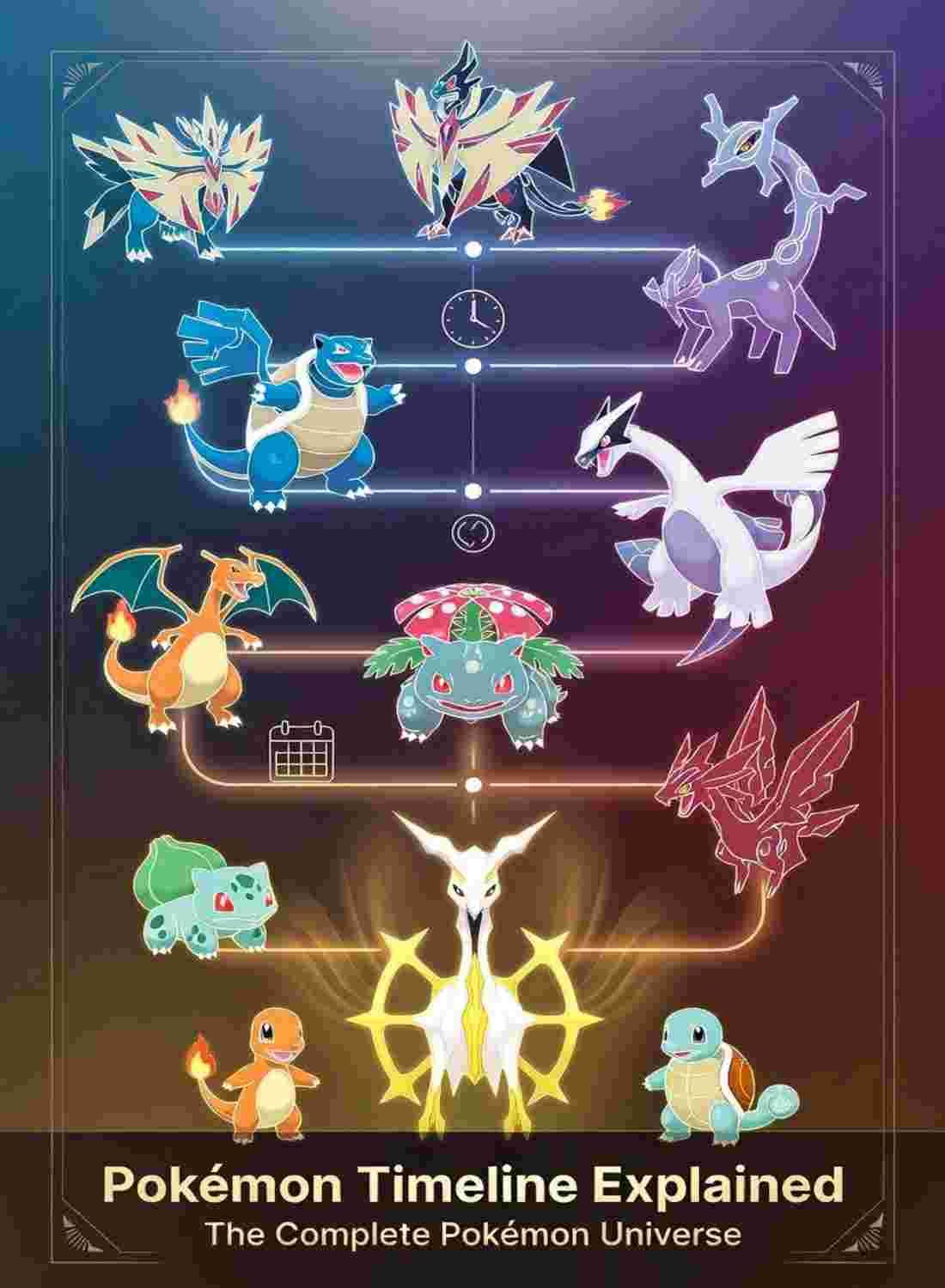
From Arceus to Miraidon, the Pokémon timeline tracks ancient myths, legendary Pokémon, and regional stories. Kanto begins the journey, Johto expands it, Hoenn introduces legendary conflicts, Sinnoh explores universal forces, Unova and Kalos focus on ideals and Mega Evolution, Alola and Galar add culture and industrial themes, and Paldea represents the modern era. Spin-offs, movies, and anime offer alternative perspectives. This timeline connects the entire Pokémon universe, giving fans a clear chronological path to explore.
Conclusion
The Pokémon universe is rich, expansive, and filled with stories of adventure, legendary Pokémon, and human ambition. Understanding the timeline allows fans to appreciate each region, generation, and Pokémon in context. Trainers, legendary creatures, and villainous teams all contribute to a universe that continues to grow. By exploring games, anime, and movies in order, fans can fully experience the depth and magic of the Pokémon world.