
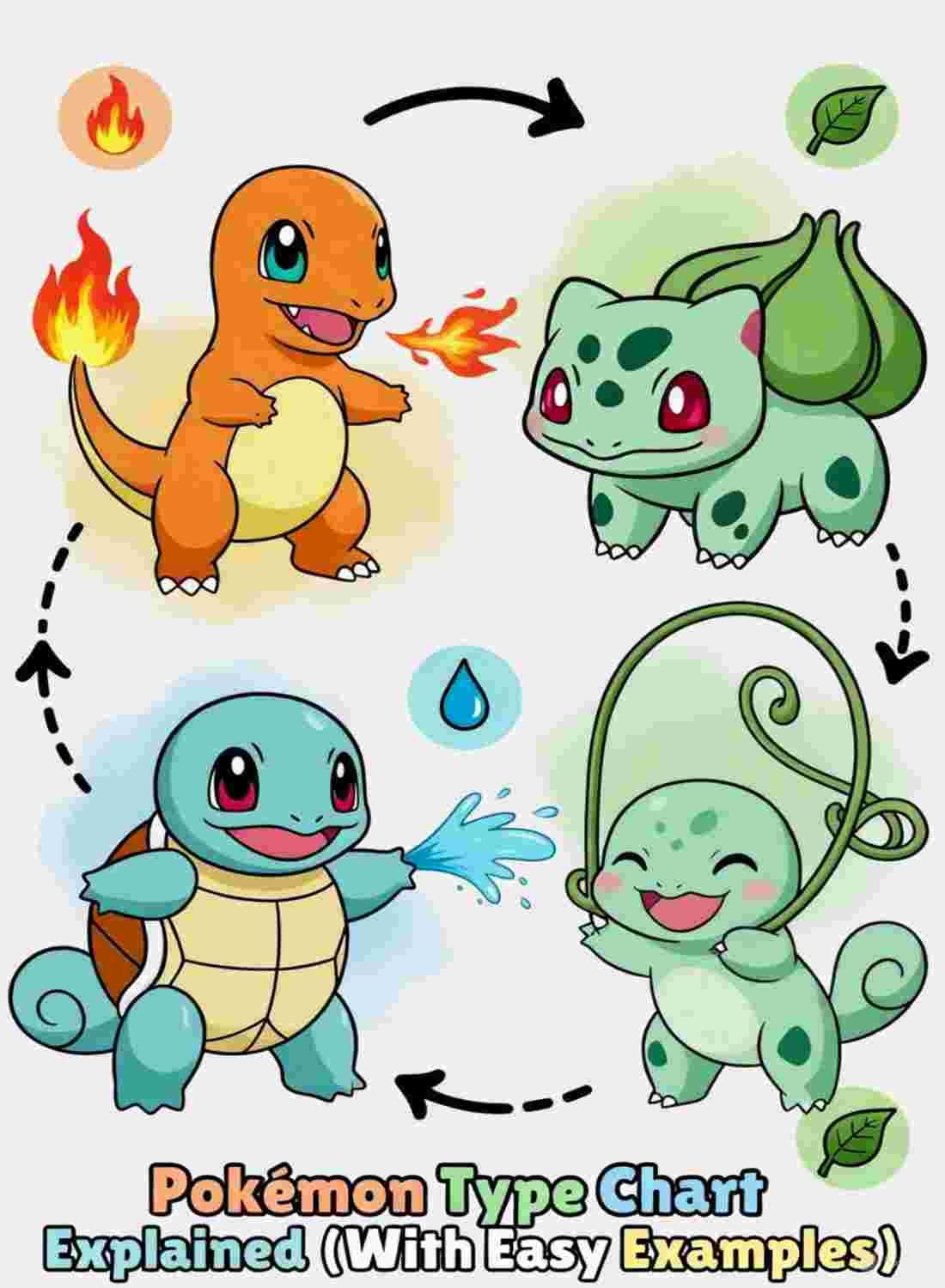
Pokémon Type Chart Explained (With Easy Examples)
Why the Pokémon Type Chart Confuses So Many Players
Many Pokémon players have experienced this situation. Your Pokémon is at a higher level, has better stats, and still loses a battle. This often happens because of the Pokémon type chart. Type matchups matter more than raw power in most battles. If you ignore Pokémon type effectiveness, even strong Pokémon can fall quickly.
The Pokémon type chart is one of the most important mechanics in the entire franchise. It decides how much damage moves deal, which Pokémon should switch in, and why some attacks feel useless. For beginners, the chart can look overwhelming. For experienced players, it becomes second nature.
This guide explains the Pokémon type chart in a simple and clear way. You will learn how Pokémon battle types work using easy examples. You do not need to memorize charts or numbers. By the end, you will understand how type effectiveness works and how to use it to your advantage.
What Are Pokémon Types and Why Do They Matter
Pokémon types define how Pokémon interact in battle. Every Pokémon has at least one type. Some have two. Types influence both offense and defense. They decide which moves deal extra damage and which moves are resisted.
For example, Fire type Pokémon are strong against Grass types. Water types are strong against Fire types. Grass types are strong against Water types. This simple loop creates balance in battles.
It is important to understand that a Pokémon’s type and its moves are not the same thing. A Fire type Pokémon can use non Fire moves. A Water type Pokémon can learn Ice moves. Move types matter just as much as Pokémon types.
Pokémon types exist to keep battles fair and strategic. Without types, battles would be decided mostly by level. Types reward smart decisions, planning, and knowledge.
Pokémon types have existed since the first generation. While new types have been added over time, the core idea has stayed the same. Every generation uses the type system to add depth and balance.
How the Pokémon Type Chart Works at a Basic Level
The Pokémon type chart follows simple rules. Every move interacts with a Pokémon’s type in one of three ways.
A move can be super effective. This means it deals extra damage.
A move can be not very effective. This means it deals reduced damage.
A move can have no effect at all. This means it does zero damage.
For example, using a Water type move against a Fire type Pokémon is super effective. Using a Fire type move against a Water type Pokémon is not very effective. Using a Normal type move against a Ghost type Pokémon has no effect.
One correct move choice can decide an entire battle. This is why understanding the Pokémon type chart matters more than memorizing numbers. The logic behind the system is easy to learn with practice.
Understanding Strengths, Weaknesses, Resistances, and Immunities
A weakness means a Pokémon takes extra damage from a certain type. A resistance means it takes less damage. An immunity means it takes no damage at all.
For example, Electric type Pokémon are weak to Ground type moves. Fire type Pokémon resist Grass type moves. Ghost type Pokémon are immune to Normal type moves.
These mechanics affect every battle. Knowing them helps you choose better moves and switch Pokémon at the right time. Many losses happen because players ignore defensive typing.
Understanding these concepts makes battles feel less random and more controlled.
The 18 Pokémon Types Explained Simply
There are 18 Pokémon types. Each one has strengths, weaknesses, and a clear role in battles.
- Normal Type
Normal types are balanced but lack super effective attacks. They are weak to Fighting types and immune to Ghost moves. Examples include Snorlax and Eevee.
- Fire Type
Fire types excel offensively. They are strong against Grass, Bug, Ice, and Steel types. They are weak to Water, Rock, and Ground types. Examples include Charizard and Arcanine.
- Water Type
Water types are versatile and defensive. They are strong against Fire, Rock, and Ground types. They are weak to Electric and Grass types. Examples include Blastoise and Gyarados.
- Grass Type
Grass types focus on status moves and healing. They are strong against Water, Rock, and Ground types. They are weak to Fire, Ice, Bug, Flying, and Poison types. Examples include Venusaur and Leafeon.
- Electric Type
Electric types specialize in speed and offense. They are strong against Water and Flying types. They are weak to Ground types. Examples include Pikachu and Jolteon.
- Ice Type
Ice types deal heavy damage but are fragile. They are strong against Dragon, Grass, Flying, and Ground types. They have many weaknesses. Examples include Lapras and Weavile.
- Fighting Type
Fighting types are powerful physical attackers. They are strong against Normal, Rock, Steel, Ice, and Dark types. They are weak to Psychic, Flying, and Fairy types. Examples include Machamp and Lucario.
- Poison Type
Poison types focus on status effects. They are strong against Grass and Fairy types. They are weak to Ground and Psychic types. Examples include Gengar and Toxapex.
- Ground Type
Ground types are excellent offensively. They are strong against Electric, Fire, Rock, Steel, and Poison types. They are weak to Water, Grass, and Ice types. Examples include Garchomp and Excadrill.
- Flying Type
Flying types are fast and evasive. They are strong against Grass, Bug, and Fighting types. They are weak to Electric, Ice, and Rock types. Examples include Pidgeot and Talonflame.
- Psychic Type
Psychic types focus on special attacks. They are strong against Fighting and Poison types. They are weak to Bug, Ghost, and Dark types. Examples include Alakazam and Espeon.
- Bug Type
Bug types are often underestimated. They are strong against Psychic, Grass, and Dark types. They are weak to Fire, Flying, and Rock types. Examples include Scizor and Volcarona.
- Rock Type
Rock types are defensive but slow. They are strong against Fire, Ice, Flying, and Bug types. They are weak to Water, Grass, Fighting, Ground, and Steel types. Examples include Tyranitar and Lycanroc.
- Ghost Type
Ghost types specialize in tricky mechanics. They are strong against Psychic and Ghost types. They are immune to Normal and Fighting moves. Examples include Gengar and Dragapult.
- Dragon Type
Dragon types are powerful and rare. They are strong against other Dragon types. They are weak to Ice, Fairy, and Dragon types. Examples include Dragonite and Salamence.
- Dark Type
Dark types counter Psychic users. They are strong against Psychic and Ghost types. They are weak to Fighting, Bug, and Fairy types. Examples include Umbreon and Hydreigon.
- Steel Type
Steel types have many resistances. They are strong against Ice, Rock, and Fairy types. They are weak to Fire, Fighting, and Ground types. Examples include Metagross and Corviknight.
- Fairy Type
Fairy types were introduced to balance Dragons. They are strong against Dragon, Dark, and Fighting types. They are weak to Steel and Poison types. Examples include Sylveon and Gardevoir.
Dual Type Pokémon Explained With Easy Examples
Many Pokémon have two types. Dual typing changes how weaknesses and resistances work.
A Pokémon with two weaknesses to the same type takes even more damage. Some type combinations cancel weaknesses. Others remove them completely.
For example, Charizard is Fire and Flying. This gives it a major weakness to Rock type moves. Meanwhile, Water and Ground Pokémon like Swampert have only one weakness.
Dual typing explains why some Pokémon feel very strong and others feel fragile.
Pokémon Type Immunities Explained Without Confusion
Immunities mean certain moves do nothing. This can confuse new players.
Normal and Fighting moves do not affect Ghost types. Electric moves do not affect Ground types. Dragon moves do not affect Fairy types.
Immunities allow smart switches and safe predictions. Learning them reduces frustration and improves battle control.
Real Battle Examples That Show the Type Chart in Action
Imagine facing a Fire type Pokémon with a Water type move. Even if your Pokémon is lower level, the damage advantage can secure a win.
Switching Pokémon to resist incoming attacks is just as important as attacking. Smart switches often decide battles more than raw power.
How the Pokémon Type Chart Affects Team Building
Balanced teams perform better than teams with repeated weaknesses.
A good team covers multiple Pokémon types. It has answers to common threats. It avoids stacking weaknesses.
Team building focuses on coverage, defense, and flexibility.
Common Pokémon Type Chart Mistakes New Players Make
Many players rely only on level. Others ignore defensive typing. Some forget dual type weaknesses.
Understanding patterns matters more than memorization.
Easy Tips to Learn the Pokémon Type Chart Faster
Practice helps more than memorizing charts.
Focus on common matchups. Learn through battles. Use logic and repetition.
Why You Do Not Need to Memorize the Entire Pokémon Type Chart
Experience replaces memorization. The game teaches type interactions naturally.
Start with basics and build confidence.
Final Thoughts: Turning the Pokémon Type Chart Into Your Advantage
The Pokémon type chart is not a barrier. It is a tool.
Understanding type effectiveness makes battles more fun and strategic. With practice, the system becomes intuitive.
Use this guide whenever you need a refresher and enjoy smarter Pokémon battles.